
How Often Should You Really Replace Your Air Filter?
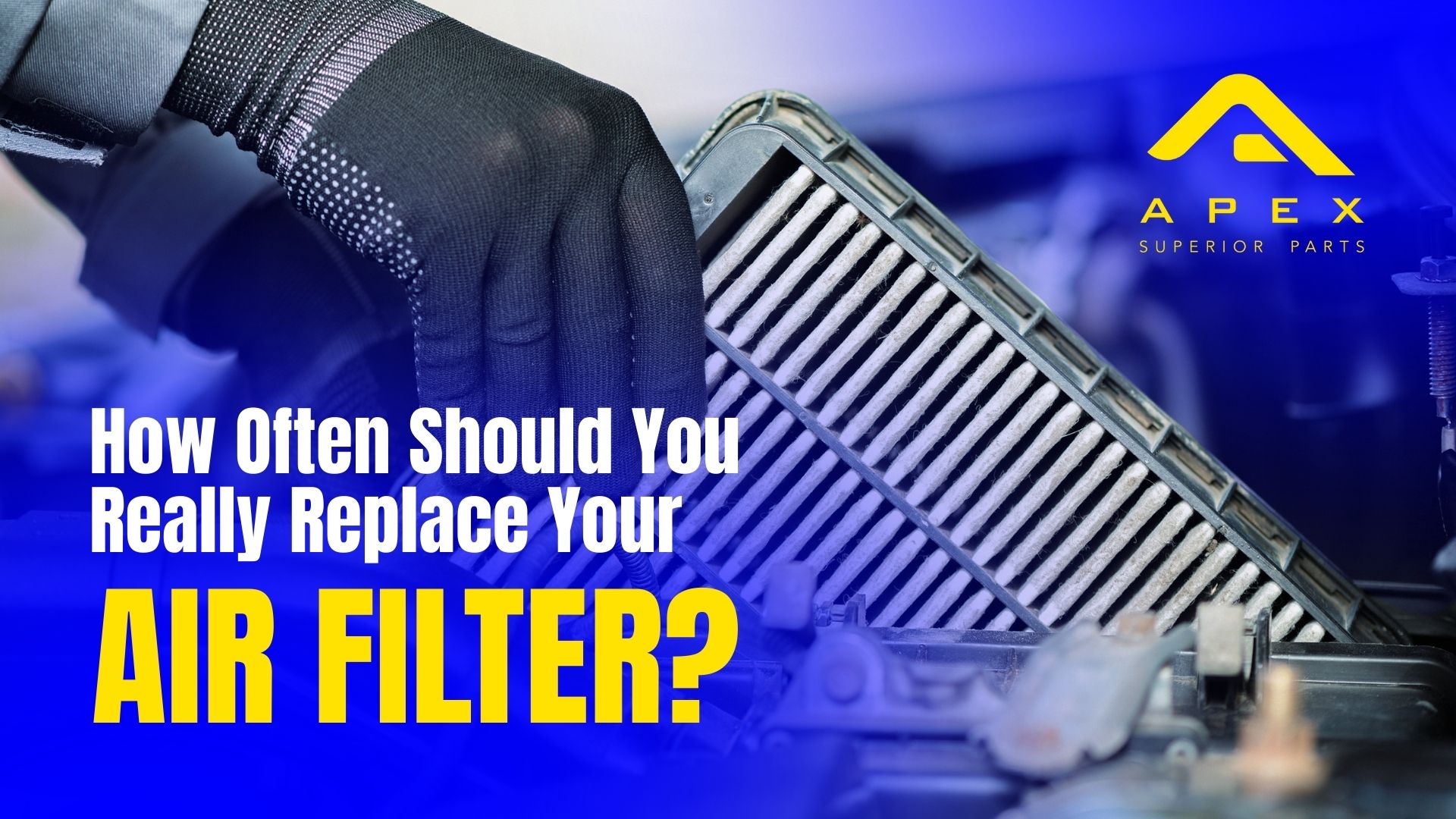
Ask three different mechanics when you should replace your air filter, and you’ll likely get three different answers. One will say every oil change, another will insist on following the manufacturer’s schedule, and the third will tell you to just look at it and decide. Welcome to one of automotive maintenance’s most debated topics – right up there with synthetic versus conventional oil and whether you really need premium fuel.
Let’s cut through the confusion and figure out what actually makes sense for your vehicle and driving conditions.
Understanding What Your Air Filter Does
Your engine is essentially a sophisticated air pump that mixes oxygen with fuel to create controlled explosions. For every liter of fuel burned, your engine inhales over 9000 to 10 000 litres of air. That’s a lot of breathing, and all that air passes through a single filter designed to trap dust, pollen, dirt, insects and whatever else happens to be floating around.
A clean air filter allows unrestricted airflow while catching contaminants. A clogged filter restricts airflow, which can reduce power, decrease fuel economy, and make your engine work harder than necessary. It’s like trying to run a marathon while breathing through a coffee stirrer – technically possible, but not ideal.
What the Manual Says
Most manufacturer maintenance schedules recommend air filter replacement somewhere between 10 000 and 15 000 kilometres under normal driving conditions. There’s usually a separate recommendation for “severe” driving conditions that cuts this interval in half or more.
Here’s where it gets interesting: most of us are actually driving under severe conditions without realizing it. Frequent short trips, stop-and-go traffic, dusty roads, and extreme temperatures all qualify as severe driving. If you’re commuting in city traffic or driving on unpaved roads regularly, you’re probably in the severe category even if your driving feels perfectly normal to you.
The Visual Inspection Method
Pull out your air filter and hold it up to a light source. If light passes through easily and the filter looks relatively clean, it’s probably fine. If it looks like it’s been vacuum-sealed in dirt or you can’t see light through it, replacement is overdue. This method works reasonably well, though it’s not foolproof.
The problem? A filter can look dirty but still flow adequately, or it can look deceptively clean while being partially clogged with fine particles you can’t easily see. Also, not everyone feels comfortable removing their air filter for inspection, which typically involves undoing clips or removing screws from the air box.
Environment Matters More Than Mileage
Someone driving 30 000 kilometres on the highway per year in clean, dry conditions might need fewer air filter changes than someone driving 10 000 kilometres annually on dusty gravel roads. Air quality matters significantly. If you’re regularly driving on dirt roads, through construction zones, or in agricultural areas during harvest season, your filter is working overtime.
Desert dwellers and those in areas with frequent dust storms need to check filters more frequently. The same goes if you park under trees that shed leaves, seeds, or other debris. Your driving environment has more impact on filter life than almost any other factor.
The Service Centre Upsell
We need to address the elephant in the service bay: air filters are a common upsell item. Some service advisors will show you a dirty filter and strongly recommend replacement even when it’s not necessary. Others keep genuinely filthy filters on hand as props to convince customers their filter looks worse than it actually does.
This doesn’t mean all replacement recommendations are scams – many are legitimate. But it pays to be informed. If someone tells you the filter needs replacement, ask to see your actual filter and inspect it yourself. A truly clogged filter is obviously dirty and restrictive.
Performance and Fuel Economy Impact
A severely restricted air filter can reduce fuel economy by up to 10 percent in older vehicles with carburettors. However, modern fuel-injected engines automatically compensate for reduced airflow, so the fuel economy impact is minimal until the filter becomes extremely clogged. You’re more likely to notice reduced acceleration and power before any significant fuel economy loss.
The Cost-Benefit Analysis
Here’s some practical perspective: most standard air filters cost from a few Rand to R100.00 to R400.00 and take about five minutes to replace. It’s one of the easiest DIY maintenance tasks – no tools required in many vehicles. Given the low cost and ease of replacement, erring on the side of changing it slightly more often than absolutely necessary isn’t a terrible strategy.
On the other hand, unnecessarily replacing a perfectly good filter every oil change is wasteful both financially and environmentally. There’s a reasonable middle ground.
A Sensible Approach
Check your air filter at every oil change or every 10 000 – 15 000 kilometres. Actually look at it, not just assume. Replace it when it’s visibly dirty, restrictive, or you’ve reached the manufacturer’s recommended interval – whichever comes first. If you drive in dusty conditions, check it more frequently.
Your vehicle didn’t come with a filter subscription service for a reason. Use common sense, trust your eyes, and don’t let anyone pressure you into unnecessary replacements. But also don’t be that person who drives 80 000 kilometres on the same filter because “it doesn’t look that bad.”
Your engine will breathe easier, and your wallet won’t suffer unnecessarily. That’s a win-win situation that doesn’t require a mechanic’s degree to figure out.